

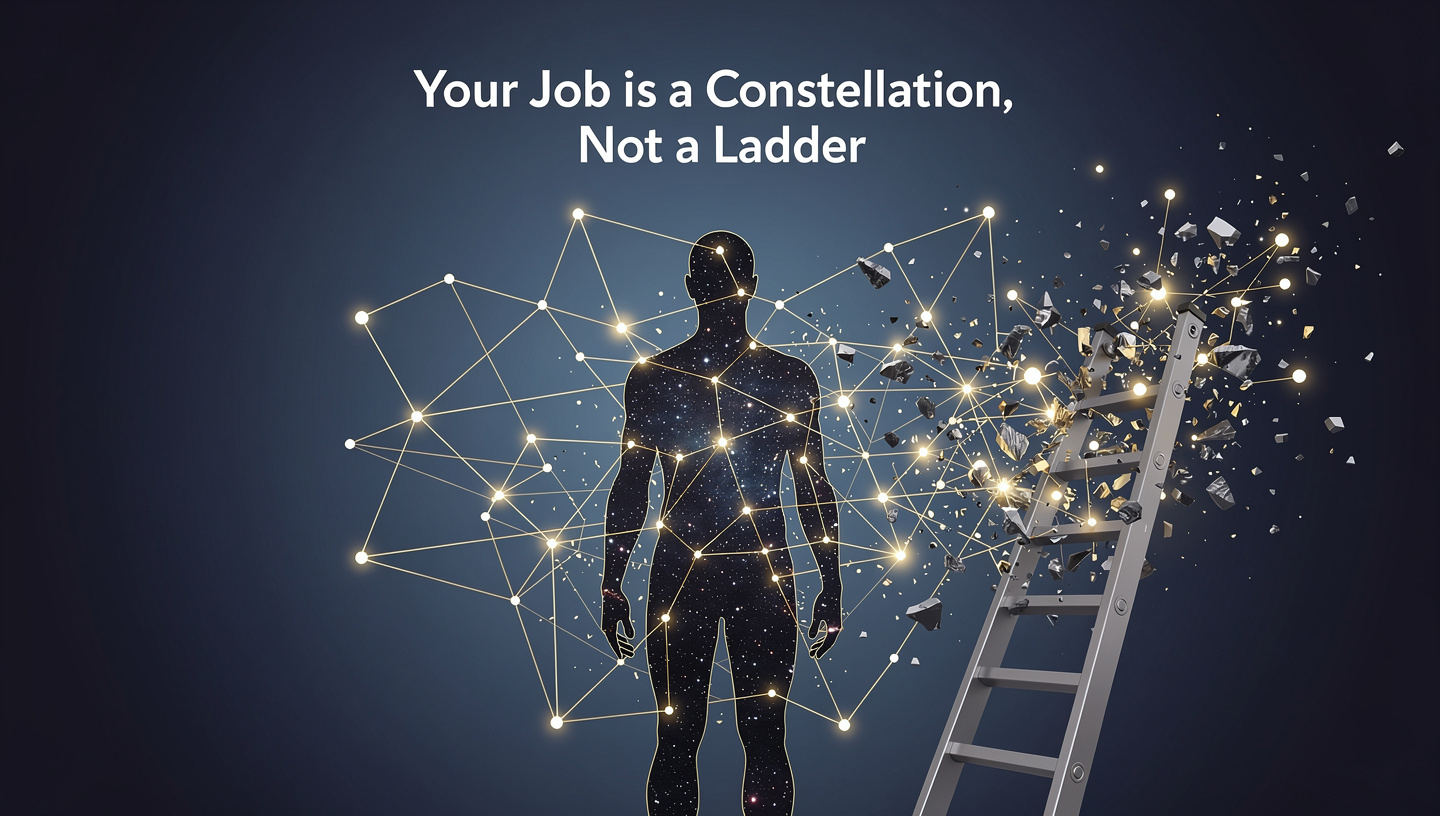
The manager's office is empty. The org chart is fading. The annual review is a relic. The very architecture of management built on hierarchies, location, and permanence is collapsing under the weight of a new reality: the borderless, fluid, and combinatorial network of human capability. Welcome to the dawn of Orchestration Management, where the manager is no longer a commander of subordinates, but a conductor of a global, on-demand symphony of skills. This is not the gig economy 2.0, this is its transcendence, and it demands a complete reinvention of the management playbook.
From Pyramid to Platform: The Manager as Network Conductor
Traditional management operates on a scarcity model: a finite set of full-time employees in a fixed location. The manager's role is to optimize this static unit. Orchestration Management operates on an abundance model: a near-infinite, global graph of capabilities accessible in real-time. The manager's primary tool shifts from the employee roster to the platform dashboard, where success is measured not by hours logged, but by problems solved and capabilities activated.
This transforms the four pillars of management:
- Planning becomes Capability Forecasting: Instead of guessing what your team can do next quarter, you map the emerging needs of your market and identify the precise combination of skills UI designer in Lisbon + regulatory expert in Singapore + storyteller in Nairobi required to meet them. You plan not headcount, but capability pathways.
- Organizing becomes Dynamic Network Assembly: You don't build a permanent team, you architect a temporary, purpose-built "Human Archipelago." The platform's trust graphs and compatibility algorithms suggest optimal configurations, but the human manager provides the nuanced judgment for complex, high-stakes orchestrations.
- Leading becomes Trust Scaffolding & Narrative Weaving: You cannot lead by authority over people who are not your employees. You lead by building a scaffold of trust, using platform-verified reputations, transparent multi-party agreements, and clear cultural protocols. You lead by weaving a compelling narrative that turns a distributed project into a shared mission, giving each contributor a sense of purpose and connection.
- Controlling becomes Ecosystem Stewardship: Control is an illusion in a fluid network. It is replaced by stewardship. You monitor the health of the collaboration through platform metrics (trust flow, milestone velocity, feedback sentiment). You intervene not to micromanage tasks, but to lubricate friction, mediate disputes using integrated tools, and ensure the network's energy flows toward the outcome.
The New Core Competencies: Literacy in a Living System
The orchestration manager masters three new literacies:
- Coordination Literacy: The ability to translate a complex objective into a searchable, matchable set of capability requirements. It is knowing that "launch a sustainable product" requires not a marketing department, but a "circular design thinker, a lifecycle assessment analyst, and a regenerative supply chain coordinator."
- Trust Calculus: Intuitive understanding of how trust propagates through a network. Knowing when to rely on a 5-star rating, when to require a multi-party escrow, and when to activate a Digital Shaman for a human-mediated introduction. It is managing risk not through contracts alone, but through the intelligent engineering of confidence.
- Value-Flow Optimization: Seeing the economic transaction not as a fee-for-service, but as the efficient distribution of value across a temporary network. Using the platform's real-time taxation and analytics to ensure fair compensation, legal compliance, and clear visibility into the ROI of the orchestrated solution.

Solving the Gig Economy's Managerial Failures
Orchestration Management directly solves the well-documented crises of the traditional gig economy:
- Isolation & Lack of Belonging: By designing projects that require deep collaboration and using platform-native communication tools that foster community, managers create temporary but meaningful cohesion. Contributors are part of a chosen team, not lonely nodes.
- Uncertainty & Instability: The platform's persistent "Unified Self" profile turns a worker's history into a stable asset. Managers don't offer job security, they offer a continuous stream of validated opportunity and the tools for personal fiscal and career management.
- Unfair Treatment and Bias: Algorithmic transparency and community governance (Platform Statesmanship) create checks and balances. Dispute resolution is built-in, and feedback is structured and contextual, moving beyond the tyranny of a single 5-star score.
The Strategic Imperative: Managing the Adjacent Possible
Ultimately, the Orchestration Manager is the explorer of the adjacent possible. They use the platform not just to execute known tasks, but to discover new, valuable combinations of human skill that the market hasn't yet articulated. They ask: "What compound capability could we form that would make that unsolvable customer problem trivial?" They manage innovation itself by facilitating the connections that make emergent solutions inevitable.
The title "Manager" will fade, replaced by Orchestrator, Network Architect, or Capability Conductor. Their power will derive not from positional authority, but from a demonstrable history of assembling brilliant, effective, and resilient human networks that consistently turn complex intentions into reality. In the Bseech era, you will not be promoted for the size of your team, but for the precision, scale, and ingenuity of the collaborations you can summon from the global fabric of human potential. The future of management is not about holding the reins tighter. It is about knowing how to listen to the music of ten thousand skilled individuals and guide them, just for a moment, to play the same perfect song.



Be the first to leave a comment.