
The map is no longer the territory. For centuries, economic opportunity was defined by geographic proximity, you could only work with people in your city, your region or your country. The internet promised to change this, but mostly delivered information exchange, not coordinated action. What we're witnessing now is something fundamentally different, the emergence of Human Archipelagos distributed networks of human capability that operate across borders as if geography didn't exist.
The Africa-Egypt Tour That Shouldn't Have Worked
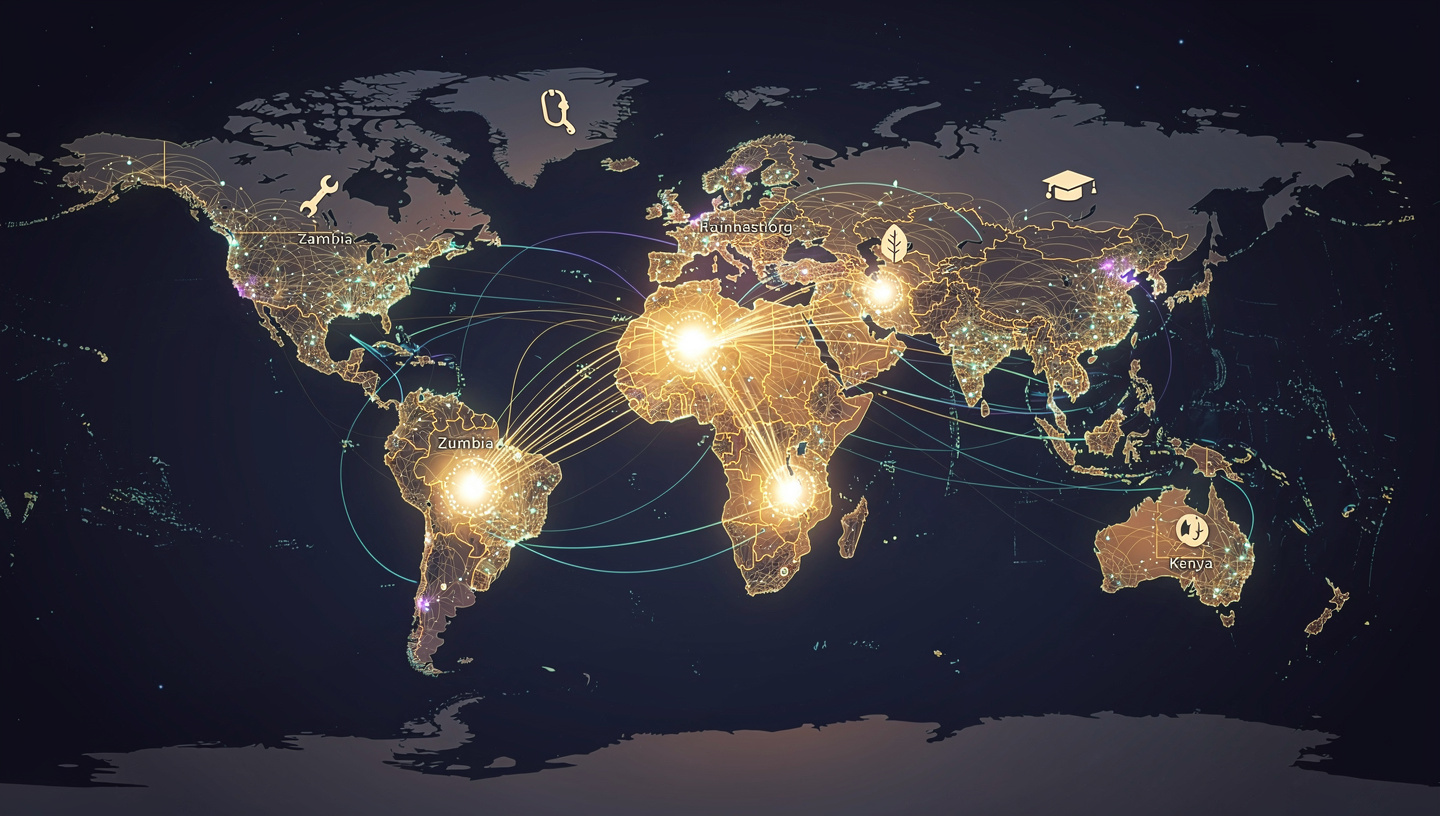
Remember the estate agent entrepreneur who needed a tour guide from South Africa to Egypt, passing through Congo? No single person possessed "Egypt-to-Congo tour guide + multiple border expertise + 5-star trust rating." Traditional platforms would have returned "No matches found." But we didn't search for a person, we searched for a capability network.
The solution wasn't one human, but five:
- A Johannesburg-based travel coordinator with regional contacts
- A Zambian border expert who understood Congo crossings
- A Tanzanian safari guide with Egypt experience
- A Kenyan logistics manager for route planning
- A Rwandan cultural mediator for local negotiations
Individually, each person had incomplete capability. Together, they formed a complete solution chain. This wasn't outsourcing, it was capability orchestration.
The Architecture of Archipelagos
Traditional economic thinking assumes capability consolidation. We build companies to bundle complementary skills in one organization. Human Archipelagos invert this logic through:
- Micro-Specialization Networks: Instead of hiring one "full-stack developer," an archipelago might connect a Nairobi UI designer, a Sao Paulo backend engineer, a Manila QA specialist, and a Berlin DevOps expert.
- Trust Propagation Pathways: Trust doesn't need to be rebuilt from zero for each connection. Our system allows trust to propagate, if A trusts B, and B trusts C, A can extend conditional trust to C based on B's endorsement strength which all are endorsed under the Bseech umbrella on accounts verifications.
- Temporal Coordination Layers: Archipelagos aren't permanent organizations but temporary capability assemblies that form around specific needs and dissolve when complete.
The Economic Implications
This changes everything about how we think about economic development:
- Developing World Leapfrogging: A skilled professional in Lagos no longer needs to emigrate to access European markets. They can participate in cross-border capability networks while remaining local.
- Urban-Rural Rebalancing: The "brain drain" from rural to urban areas reverses when physical location matters less than network position.
- Economic Resilience: Distributed networks are less vulnerable to local economic shocks. If one node goes offline, the network can reconfigure.
The Platform's Role as Archipelago Cartographer
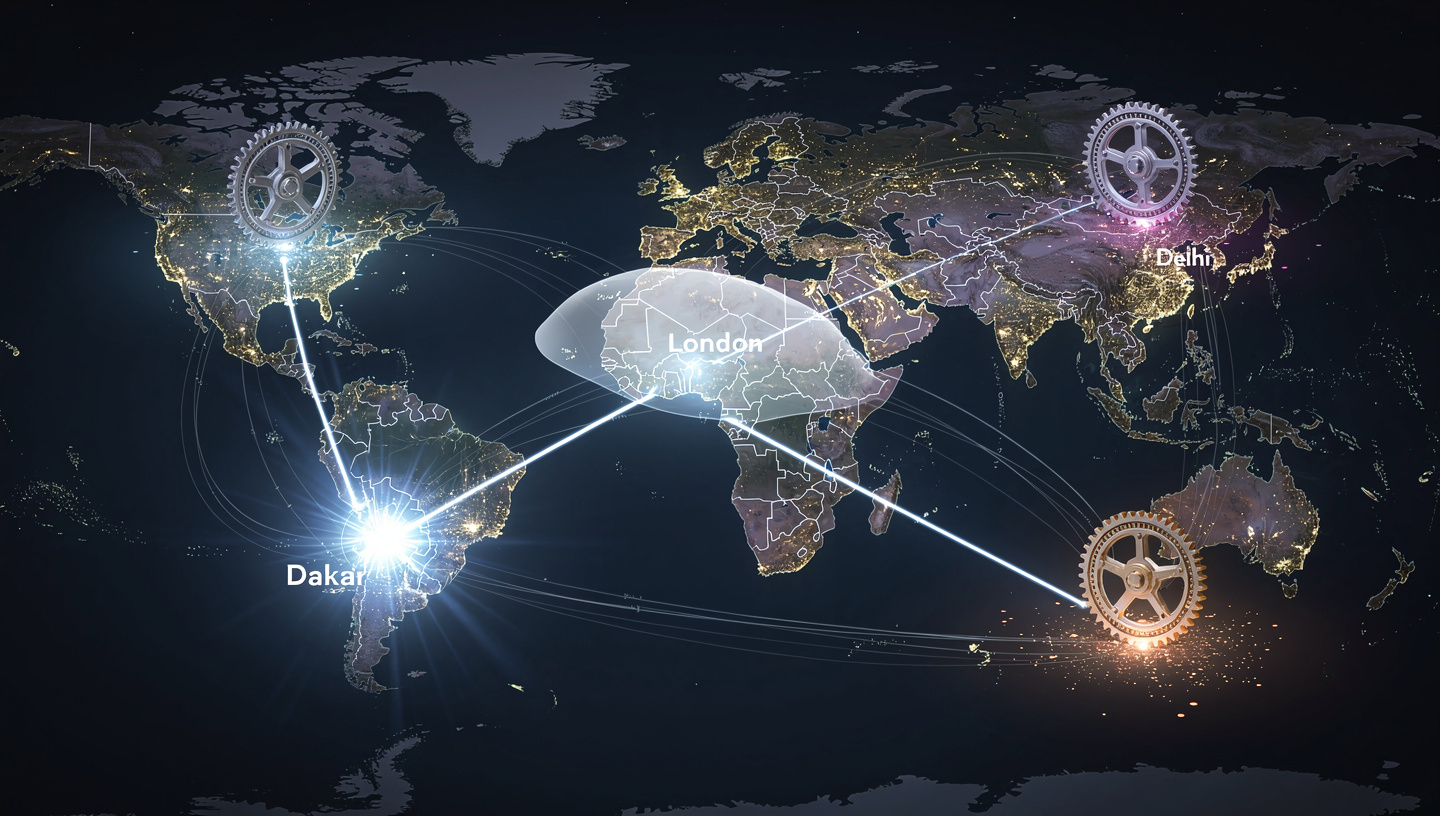
We're not just matching people to tasks; we're mapping capability geography. Our algorithms don't ask "who can do this?" but "what combination of who's can do this together?" This requires:
- Capability Vector Mapping: Understanding not just what people can do, but how their capabilities combine with others'
- Trust Pathway Analysis: Modeling how trust flows through networks
- Coordination Cost Prediction: Estimating the communication overhead of different network configurations
The New Economic Geography
We're moving from:
- Location-based economies (Silicon Valley, Wall Street)
- To network-based economies (Human Archipelagos)
Your economic opportunity is no longer determined by where you live, but by:
- Your unique capability vectors
- Your network connectivity
- Your trust capital
- Your coordination literacy
The Challenge of Coordination
The hard part isn't finding capability, it's coordinating it. That's why our platform includes:
- Multi-party agreement systems
- Cross-cultural communication protocols
- Distributed accountability frameworks
- Automatic milestone tracking
The Future is Archipelagic
The nation-state model of bundled citizenship is giving way to the archipelago model of distributed capability. You're not just a citizen of a country, you're a node in multiple capability networks spanning continents.
This isn't the gig economy, this is the networked capability economy. And it's creating a world where the most valuable skill isn't what you can do alone, but how well you can coordinate what we can do together.


Be the first to leave a comment.