

As we stand at the threshold of building civilizational infrastructure, Digital Organisms, Emergent Intelligence, the Un-Interface, we must codify our prime directive. It cannot be "move fast and break things". It must be a law of balance, as fundamental to our work as thermodynamics is to physics.
We hereby establish the First Law of Coordination: For every new protocol that increases the power, speed, or scale of human coordination, an equally powerful, automated, and transparent ethical constraint must be designed and deployed in tandem. Power without constraint is tyranny, even if the power is distributed.
The Inherent Asymmetry and the Need for Counter-Weight
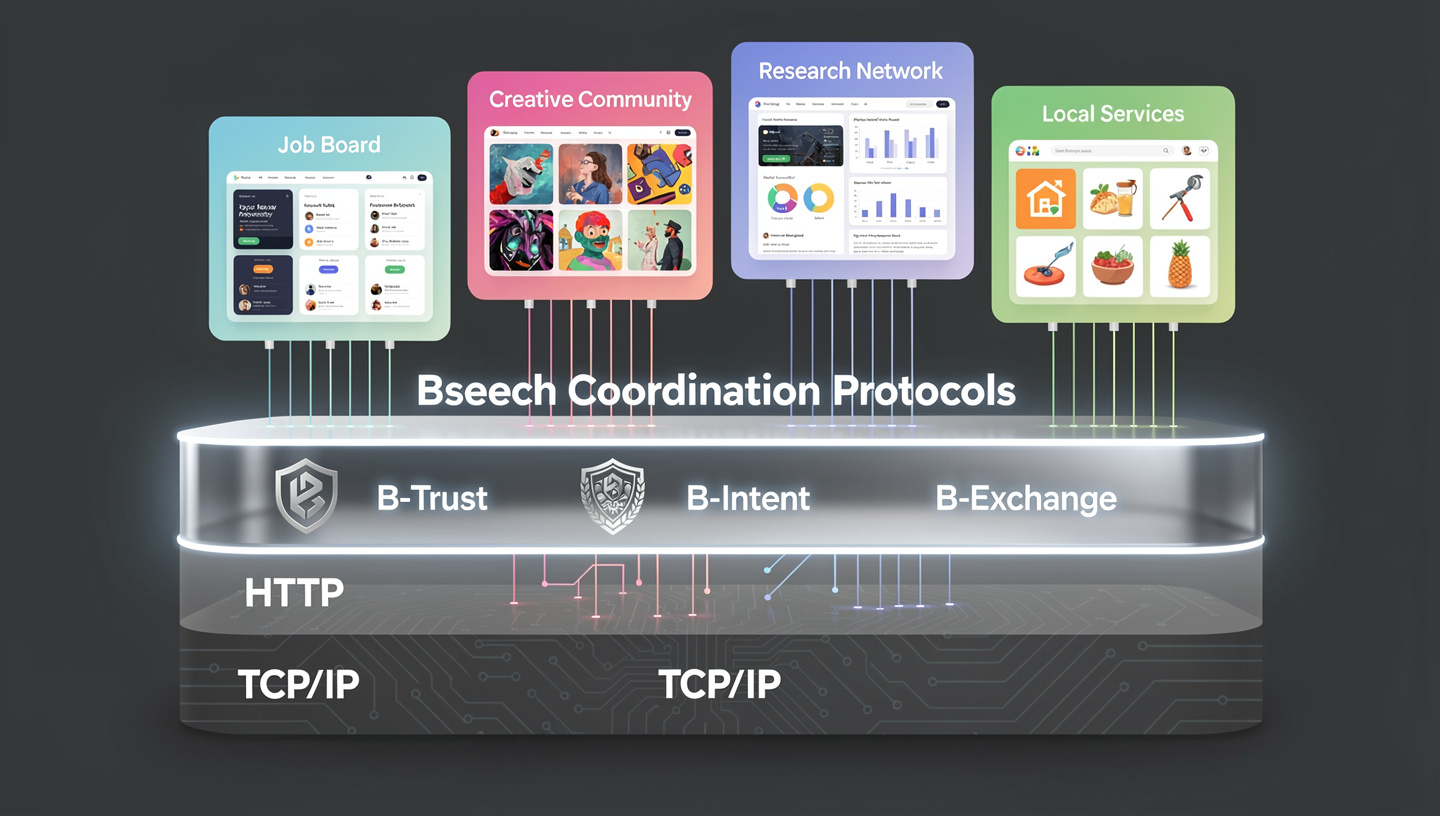
Coordination protocols are force multipliers. The B-Trust Protocol multiplies reputation. The B-Intent Protocol multiplies the speed of commitment. The Synthesis Engine multiplies the translation of will into reality. This creates an asymmetry: it becomes exponentially easier to do things, but our collective wisdom on what should be done evolves slowly. Without embedded constraints, the system's power will inevitably be used for catastrophic coordination, for oppression, manipulation, or reckless scale. The constraint is not a suggestion, it is the necessary counter-weight that keeps the flywheel of progress from spinning into destructive frenzy.
Constraint-by-Design: Examples from the Bseech Stack
This is not about Terms of Service. It is about protocol-level ethics.
- For the Trust Graph (Power: To validate anyone): The constraint is the Right to Contextual Sunset. A reputation score cannot be eternal. The protocol must automatically apply a decay function or a re-verification requirement for dormant trust, and allow for the cryptographic "sealing" of past failures after a period of demonstrated good conduct. This fights the tyranny of the permanent digital record.
- For the Collective Intelligence Protocols (Power: To identify optimal human combinations): The constraint is the Diversity Resilience Check. The protocol cannot recommend team formations that consistently exclude nodes from certain geographic, cultural, or disciplinary clusters unless a certified Digital Shaman overrides it with cause. This fights the emergence of homogenizing, elitist "super-groups" that would starve the wider network.
- For the Un-Interface & Synthesis Engine (Power: To manifest intent effortlessly): The constraint is the Intent Impact Simulation. Before a major resource commitment is automated, the system must run a lightweight simulation of secondary and tertiary effects (social, environmental, economic) and present a simple "foresight dashboard" to the human instigator. "You intend to mobilize 10,000 workers to this region. Model predicts a 85% chance of local housing market collapse. Acknowledge or revise?"
The Role of Digital Shamans as Constraint Keepers
As the system becomes more automated and invisible, the Digital Shaman's most critical role evolves. They are the keepers and calibrators of the ethical constraints. They audit the constraint algorithms for bias. They interpret the "foresight dashboards" for users. They hold the ultimate human override key for the system, able to halt a runaway coordination process that is legal by protocol but unethical by the community's lived principles. They ensure the machine's efficiency serves humanity, not the other way around.
The Recursive Law: Constraints That Learn
The First Law itself must be recursive. The ethical constraints cannot be static rules. They must be learning systems in their own right, informed by the outcomes they shape. A constraint that overly stifles innovation must be loosened, one that fails to prevent harm must be tightened. Their evolution must be as participatory and transparent as the governance of the protocols they guard.
We are building a new world. The First Law of Coordination is our pledge that this world will have not just capability, but conscience, not just intelligence, but wisdom. It is the acknowledgment that our greatest technical achievement will be a system powerful enough to solve our grand challenges, yet constrained enough to never become one of them.



Be the first to leave a comment.